How I Taught Myself English — and Reached C2 Without a Classroom
There is a moment in language learning that nobody warns you about. You have been studying for months. You can read reasonably well. You understand the grammar. You know a respectable number of words. And then someone speaks to you in that language at normal speed, with real pronunciation, about a real subject — and you understand almost nothing.
That gap between knowing a language and actually using it is one of the most humbling experiences a learner can have. I have been through it more than once. With English. With French. Each time it taught me something important — not just about language, but about how learning actually works.
I am not a linguist. I have no special gift for languages. What I do have is a method that emerged from trial, error, and a fair amount of stubbornness — and it eventually took me from a factory floor in the Czech Republic to a Cambridge C2 proficiency certificate in English, and a DELF B2 in French. Self-taught, almost entirely.
How It Started: The Free Course I Stopped Attending
My English journey began, as many things in my life did, out of necessity rather than passion. My employer at the glass factory offered free English courses — two levels. I signed up for both. I liked the idea. I showed up regularly. And fairly quickly, I noticed something that changed how I thought about formal learning.
I was learning more at home than I was in the classroom.
Not because the course was bad. It wasn’t. But the pace was designed for a group, which meant it was too slow for someone who had decided to take the subject seriously. At home, I could work at my own speed, revisit what I didn’t understand, push ahead when I was ready. The classroom had to wait for everyone. Home only had to wait for me.
So I stopped attending the courses and started learning on my own. This was not a rejection of formal education — it was a recognition of how I personally absorb information best. That distinction matters. What works for one person can be exactly wrong for another. Knowing which type you are is one of the most useful things you can discover about yourself.
The Self-Taught Method (And Its Hidden Flaw)
My method was straightforward, though not easy. I immersed myself in English as completely as I could from home. I studied grammar systematically. I read. I listened. I built vocabulary deliberately rather than randomly. I worked through the language as if it were a subject with a structure to master — because it is.
This approach suited me well. I am, by nature, someone who enjoys learning alone first — building a theoretical foundation before I need to use what I’ve learned in the real world. I like to understand the map before I start walking.
But there is a flaw in this method, and I discovered it at exactly the wrong moment: when I first had to actually speak to someone.
You can know a language thoroughly in your head and still be completely lost when another human being starts using it at full speed.
This is the hidden flaw of self-teaching: it builds competence beautifully, but it cannot replicate the experience of live communication. Real conversation has interruptions, accents, idioms, silences that need to be filled, and the mild panic of knowing that another person is waiting for you to respond. No textbook prepares you for that.
I needed a different kind of help.
What a Teacher Is Actually For
I found Lenka. She was an English teacher who agreed to work with me — not to teach me the basics, which I already had, but to give me someone to have a real conversation with, and to prepare me for the Cambridge FCE exam.
Working with Lenka clarified something I have believed ever since: a teacher’s most important role is not to transfer information. Information is widely available to anyone willing to look for it. A teacher’s most important role is to create the conditions for practice that you cannot create alone.
You cannot practice a conversation by yourself. You cannot get feedback on your spoken fluency from a textbook. You cannot replicate the experience of being gently corrected in real time, of searching for a word under mild pressure, of discovering which parts of your language actually hold up when tested against another person.
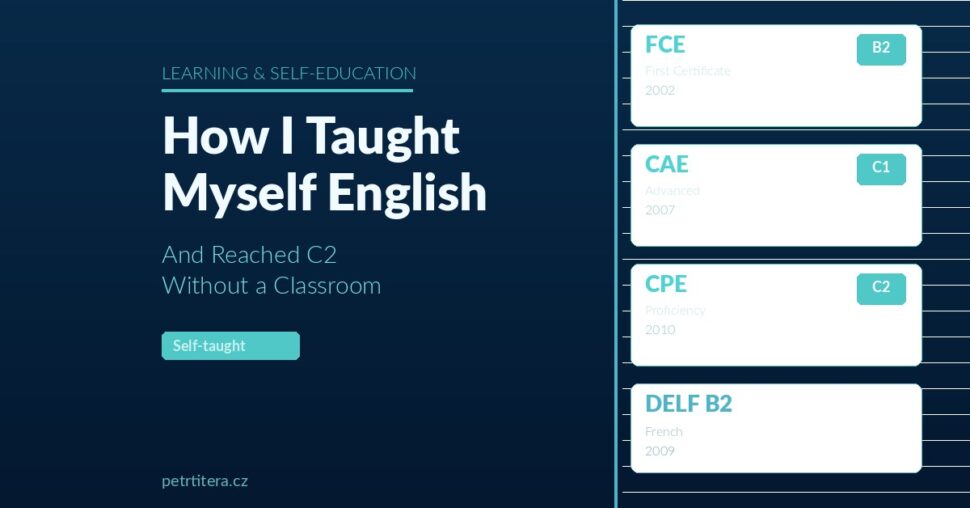
In 2002, I passed my FCE. In 2007, the CAE. In 2010, the CPE — Cambridge’s highest level, equivalent to C2. Each certificate followed the same pattern: intensive self-study first, then a teacher or conversation partner at the right moment. The ratio was probably 80:20 — eighty percent alone, twenty percent with someone else. But that twenty percent was not optional. It was essential.
French, and What I Learned the Second Time
After English, I applied the same approach to French. I started alone, studied methodically, and made reasonable progress. DELF B1 in 2008. DELF B2 in 2009. Two certificates in two years.
What French taught me that English hadn’t was this: the method scales. It works not because English is easy, or because I have a particular aptitude, but because the approach itself is sound. Build systematically. Go deep before you go wide. Treat language as a structure, not a collection of phrases to memorize. And when you have enough foundation, find a human being to practice with.
I also learned that I genuinely enjoy languages. Not as a means to an end, but as objects of interest in themselves — the way they are structured, the way they reveal the thinking of the culture that produced them, the way learning one makes you look differently at your own. There is something quietly profound about being able to inhabit another language, even partially.
What This Means if You Want to Learn Something
I am not suggesting that everyone should abandon courses and classrooms. For many people, structured group learning is exactly right. What I am suggesting is that it is worth asking, honestly, how you personally learn best — and then building around that, rather than around what is most conventional or most available.
A few things I believe, based on my own experience:
Self-teaching works best when combined with deliberate structure. Wandering through a subject randomly is not the same as teaching yourself systematically. The discipline of a course can be replicated alone, but it has to be replicated intentionally.
A teacher or partner is not a crutch. Knowing when you need another person is not a sign of weakness in your self-teaching. It is a sign of honesty about what solo practice cannot provide.
Certificates are useful, but they are not the point. They mark a level of competence and give you something to aim for. But the real payoff is the capability itself — the ability to read, think, and connect with people in another language.
The Question I’d Leave You With
Is there something you have been meaning to learn — a language, a skill, a subject — that you have been waiting to start because the right course hasn’t appeared, or the right moment hasn’t arrived?
The right course may never appear. The right moment almost certainly won’t.
What I found — and keep finding — is that the best time to start learning something is when you decide it matters. Not when everything is in place. Conditions are never perfect. But curiosity, combined with a reasonable method and a little stubbornness, turns out to be enough.
It was enough for a factory worker with an English dictionary and no particular reason to believe he’d end up anywhere different.
 The Quiet Trap: Why Adults Stop Learning (And How to Escape It)
I want to tell you about a pattern I have noticed —…
 The Other Kind of Motivation — And Why It Works
There is a version of this story I was supposed to tell.…
 Why I'm Learning AI at 40+ — And Why You Probably Should Too
A few years ago, someone asked me what I thought about AI.…